8 GB of video memory: is it still enough in 2026?
Two of our three PCs have graphics cards with 8 GB of memory. Using current tests, we show when that is enough, when it is not and which single setting in the game makes the difference. Even where the answer speaks against our own PCs.
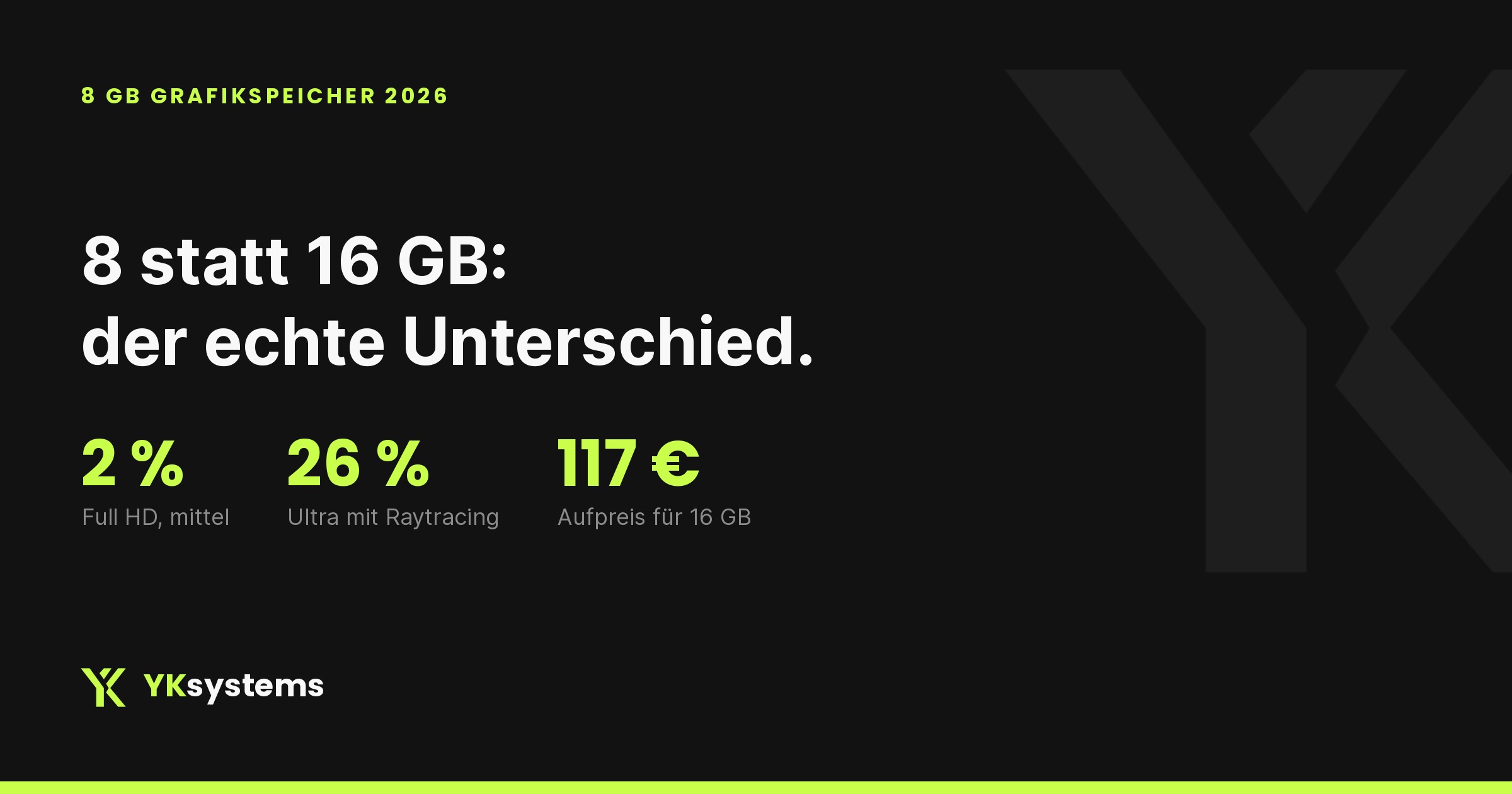
Two of our three PCs, the YKON Entry and the YKON Core, have a graphics card with 8 GB of memory. In forums you often read just one sentence about this: 8 GB is no longer enough in 2026. If that is true, we are selling two out of three PCs with a flaw.
So we looked at what current tests really show. The short answer: it almost always comes down to a single setting in the game. The long answer is here, including the parts that are uncomfortable for us.
What video memory actually is
The graphics card has its own memory, separate from the PC's RAM. You can think of it as a workbench: everything currently needed for the image lies there within reach. Above all the textures, that is, the surfaces of walls, clothing, floors and faces.
As long as everything fits on the workbench, you notice nothing of the memory. If it gets too full, the card has to fetch parts from normal RAM, and that route is much slower. The game then does not simply get evenly slower. It stutters when you turn around quickly, surfaces stay blurry for a moment before they become sharp, and in the worst case the game crashes.
Important here: more memory does not make a graphics card faster. It only prevents it from being slowed down.
What the tests show
This is measured most cleanly with a card that exists in two versions. The GeForce RTX 5060 Ti is sold with 8 and with 16 GB, everything else is the same. Tom's Hardware compared both in 21 games. This is how much slower the 8 GB version was on average:
| Resolution and setting | 8 GB versus 16 GB |
|---|---|
| Full HD, medium details | 2 % slower |
| Full HD, highest details | 11 % slower |
| Full HD, highest details, games with ray tracing | 26 % slower |
| WQHD, highest details | 18 % slower |
| WQHD, highest details, games with ray tracing | 40 % slower |
Full HD is the usual resolution of 1920 by 1080 pixels, WQHD the next higher one at 2560 by 1440. Ray tracing is a technique for particularly realistic light and reflections that needs additional memory.
The table tells a clear story. At medium details in Full HD the difference is barely measurable. The higher the settings and resolution, the more the missing memory costs.
In May 2026, ComputerBase came to the same picture with the RTX 5060 and RTX 5050, both with 8 GB: in Full HD without ray tracing, 8 GB does not noticeably slow things down in many games. With ray tracing it does, and there, on the RTX 5060, just turning down the textures brought around 10 percent more frames per second on average.
One game as an example
How tight it can get is shown by Indiana Jones and the Great Circle, one of the most memory-hungry games of recent times. Notebookcheck measured on a laptop with an 8 GB card how much video memory it uses in Full HD:
| Setting | video memory used |
|---|---|
| Medium | around 6.9 GB |
| High | around 8.3 GB |
| Very high | around 9.3 GB |
At medium settings the game ran smoothly. One level higher and it no longer fits on the workbench, and it can crash. Between “runs perfectly” and “does not run” there is exactly one level here.
The one setting
From this follows the most important tip in this article: if a game stutters on an 8 GB card, first turn the texture quality down one level. Not the resolution, and not everything at once.
- Textures are the biggest item in video memory. One level less often saves more than a gigabyte.
- In Full HD on a normal monitor you can usually hardly see the difference between “High” and “Very high”.
- Many current games show in the graphics settings how much memory the chosen settings need. If the display stays below 8 GB, all is well.
- Ray tracing is the second big consumer. If you can do without it, switching it off gains memory and frames per second.
The typical signs of full video memory: stutters when looking around quickly, surfaces that first appear washed out and then sharp, and crashes in areas that worked before.
What this means in everyday use
| What you play | Is 8 GB enough? |
|---|---|
| Fortnite, Counter-Strike 2, Valorant, League of Legends, Minecraft | Yes, without restriction |
| Big new games in Full HD at high settings | Yes, textures one level down if needed |
| Big new games in Full HD at highest settings with ray tracing | Borderline, you noticeably lose frames per second here |
| WQHD or 4K | No, 16 GB is the right choice here |
| Images or text with AI on your own PC | Only small models, more in the article AI on your own PC |
Why 8 GB cards still exist at all
Because memory is expensive right now. Since mid-2025, AI data centres have been buying up a large part of the world's memory production, and that affects graphics cards too. More in the article Why PCs are getting more expensive right now.
What double the memory costs can be seen with the Radeon RX 9060 XT, which also comes in both versions. According to PC Games Hardware, on 13 October 2026 it cost from 446 euros with 8 GB and from 564 euros with 16 GB. 117 euros extra, just for the memory.
And there is a second reason why 8 GB will not become useless overnight. According to the Steam hardware survey from July 2026, 8 GB is still the most common configuration on Windows PCs, around one in three has exactly that much. No game publisher can afford to lock out a third of its customers. New games will therefore also run with 8 GB, just not at the highest settings.
What this means for our PCs
Now the uncomfortable part, because it affects us directly.
YKON Entry, with RTX 5050 and 8 GB. Here memory is rarely the bottleneck. The RTX 5050 is an entry-level card and is not built for the highest settings with ray tracing. At the settings it is meant for, the memory matches the performance.
YKON Core, with RTX 5060 and 8 GB. Here the question is justified. In some games the RTX 5060 would have enough performance for the highest settings, and that is exactly where it hits the 8 GB. For Full HD at high settings the Core is a good choice. But if you know you want to play the latest big games with everything the settings allow, or keep the PC for five years without upgrading, you should take 16 GB.
YKON Pro, with Radeon RX 9060 XT and 16 GB. For WQHD, for the highest settings and for anyone who does not want to ask the memory question in the first place.
In between there is an option that is not on the page: on request we also build the Core with a 16 GB graphics card. We calculate the extra cost at the current price, because graphics card prices are changing weekly right now. Write to us via the request form which games you play and on which monitor. If 8 GB is enough for you, we will tell you that too.
In short
- In 2026, 8 GB is enough for Full HD at high settings. At medium settings the difference to 16 GB is barely measurable.
- At the highest settings with ray tracing and from WQHD upwards, you noticeably lose frames per second. There 16 GB is the better choice.
- If a game stutters, first turn the textures down one level.
- 16 GB currently costs around 120 euros more. Whether that is worth it is decided by your monitor and your games, not by a rule of thumb.
Sources: Tom's Hardware, RTX 5060 Ti with 8 GB versus 16 GB in 21 games (August 2025). ComputerBase, graphics cards up to 300 euros tested (May 2026). Notebookcheck, Is 8 GB VRAM enough for modern games? (December 2025). PC Games Hardware, price comparison of 13 October 2026. Steam hardware survey July 2026. Graphics card prices are currently fluctuating strongly and may have changed since writing.
Was this helpful?
Which PC fits?
Entry, Core and Pro side by side: specifications, price and frame rates in popular games.
Compare the systemsStill have questions?
Tell us what you have in mind. We reply personally within 24 to 48 hours on working days, without sales pressure.
Ask for adviceNew articles by email
The new guides and our news once a month, in German. As a thank you, you get €25 off your first YKON.